

How many Emails do you draft a day? How many Emails do you receive per day? How many times have you unsuccessfully tried concepts like the "INBOX ZERO" principle? And finally: How many hours do you spend per day to read and spread Emails?
Here is our ultimate work hack on how to reach your "zero inboxes" goal:
Stop writing Emails.
It is as simple as this! There is a German saying called: who sows emails will crop emails – which means:
Whenever you author an Email to one of your business partners or colleagues you will normally expect to or get a reply. When you address this Email to more than one person you will engage a respective amount of people reading & responding to it. And here comes simple math if reading your Email will take at least 2 minutes of working hours (without reacting to it):
· 1 Email – 1 Addressee = 2 minutes of working time
· 1 Email – 10 Addressees = 20 minutes of working time
· 20 Emails – 10 Addresses = 400 minutes of working time (≈ 1 full working day!)
What can we learn from this?
This means that if you have only 13 employees in your company, you can assume in purely arithmetical terms that one of them spends the full year reading useless emails. One out of thirteen = 7,6%!
Imagine a company with 1.000 employees – thereof
76 doing nothing but reading useless Emails the entire year!
Well – I know that this is somehow a kind of a naive assumption. But there is another suspect in writing Emails:
As flat hierarchies, agility, collaboration & trust – just to name a few - are keywords of what we call #NEW WORK and because remote work & home office are currently discussed as the #NEW NORMAL in business life and since one of the key success factors for both concepts is TRANSPARENCY the issue with Emails is:
Email is the opposite of transparency!
Why?
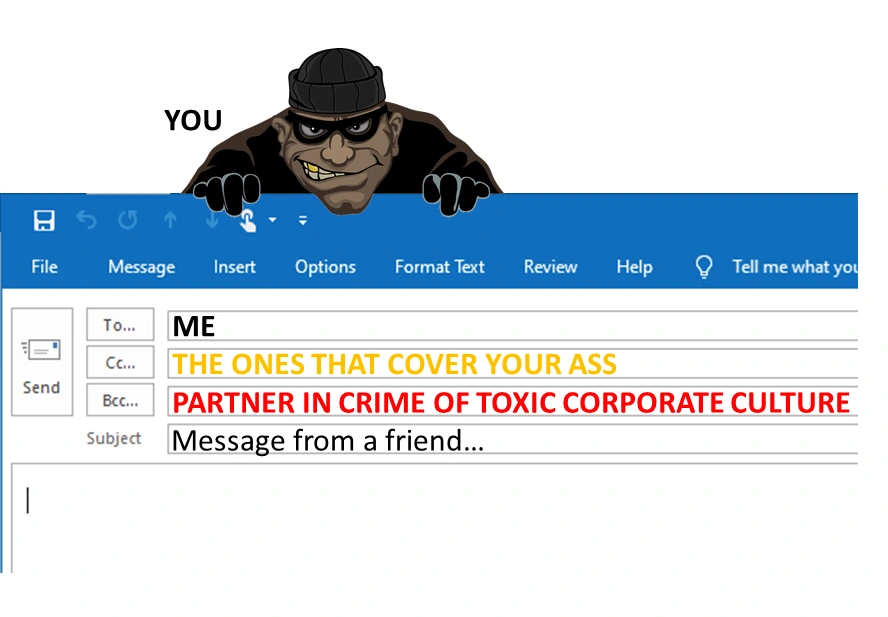 Original illustration from the LinkedIn article.
- You always put one or a selected group of people in "TO"
- Besides, some of you put a selected group of people in "CC"
- Some of you also use "BCC"
The result:
In writing Emails, you spread information to selected groups of people – this is not full transparency! Putting people in CC is a bad habit because it will lead to productivity drain (see above) and it is sometimes a kind of "cover my ass" attitude. I´ve never seen "cover my ass" being an element of glossy PowerPoint slides headed with "Our Core Values" but many Emails of this kind in the same companies. At the latest, when you put people in BCC, you actively spoil the corporate culture and the recipient of bcc emails becomes a partner in the crime of toxic corporate culture by letting this happen without immediate and adequate feedback to its sender.
Want simple alternatives to make NEW WORK CULTURE alive?
- go and see & walk the talk – go to the shop floors and offices of your employees instead of writing Emails – (please do not use the current Corona situation as a general excuse)
- use collaboration tools like Slack, MS Teams, or HipChat to electronically spread information instead of writing emails
- use your phone to have a synchronized communication instead of asynchronous email communications
and a special one
4. send a handwritten letter to your employee to simply say THANK YOU!
But in any case: Think twice before authoring an Email next time and if not avoidable reduce the total amount of addressees for the sake of productivity and corporate culture of your organization.
Artikel teilen↗
What does this mean for your organisation?
Let’s explore your specific challenge together.
Let’s talk↗