

Nothing paralyzes organizations more than decisions that are not made: Be it long overdue personnel decisions, investment decisions that are constantly delayed, or - and this is what we experience most often – prioritization of decisions that have not been made: Every project has an A-priority - and some have double A!
And did you know: the word priority entered the English language around 1400 and was originally used only in the singular. It meant the primary or most important thing. For the next 500 years, it continued to be used only in the singular. It was not until around 1900 that it was also used in the plural and since then humankinds have spoken of priorities. As if by changing the word, you could also change reality and as if somehow, we could now make several "priority" matters our goal.
In my daily work in organizations, I often observe that leaders and teams shy away from taking (important) decisions. Decisions are being postponed or analyzed until nobody knows what is right or wrong anymore. Leaders lack the courage to take decisions because of the following reasons:
- Perfectionism: I always have to make the perfect decision
- Fear of failure: A wrong decision will have bad consequences
- Fear of being judged by others: I will lose my credibility in case I am wrong
- Doubts about legitimacy: Am I the right person to make this decision?
- Learned helplessness: My decision will not be implemented anyway
How many leaders do you know shy away from taking important decisions? How many projects, workshops & meetings do you know in which a lot is said but, in the end, nothing is decided?
This is why I would like to share a simple & hands-on decision-making tool that I very often and successfully apply in workshops. A method that accelerates decisions. It is called “decision making by consent” and it follows a 3-step approach:
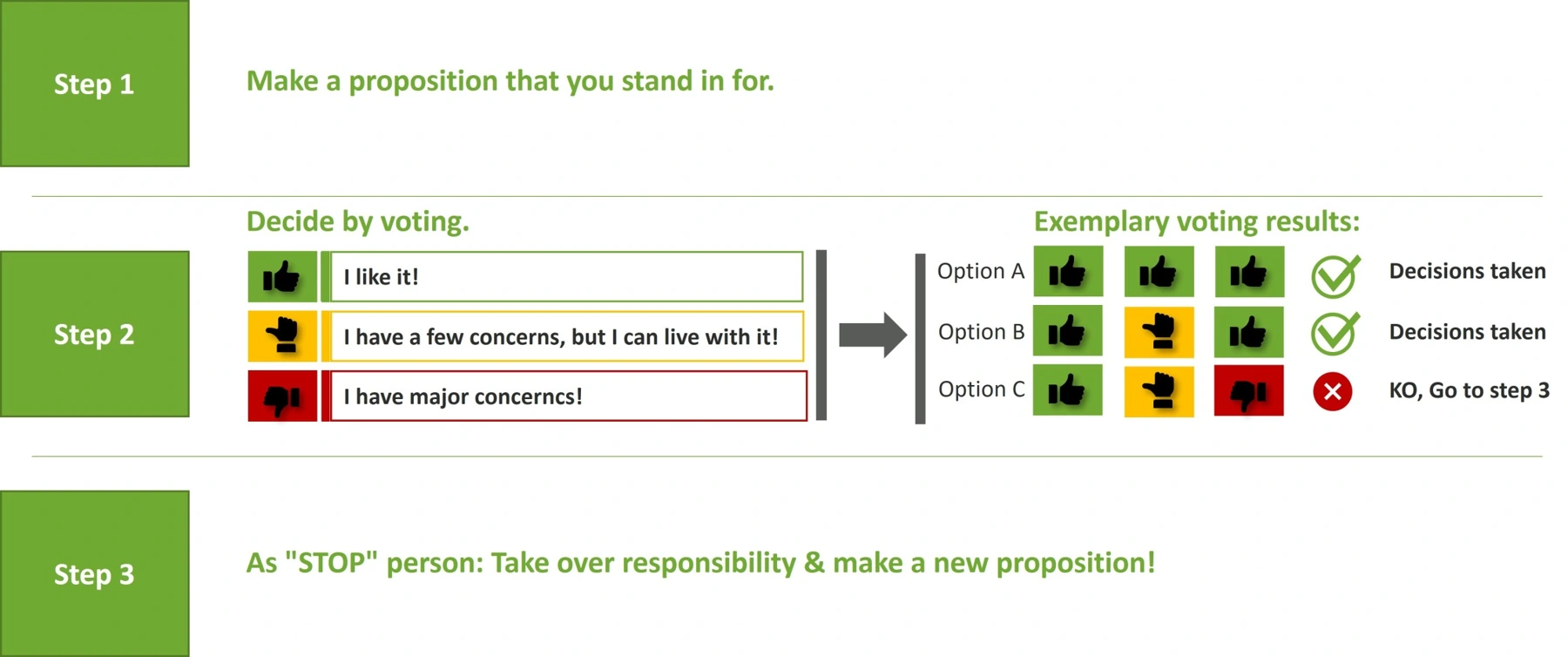 Original illustration from the LinkedIn article.
Step 1: Make a proposition that you stand for.
The proposition needs to be concise and formulated in a way that you can decide on it by voting. Before voting, answer questions that aim at clarification.
Step 2: Decide by voting.
Every decision-maker votes by using his/her thumb:
- Thumb up = I like the proposal
- Thumb left (or right) = I have a few concerns, but I can live with the proposal
- Thumb down = I have (at least one) major concern – I can’t live with the proposal
In every decision situation without any thumbs down, the decision is taken. In case of (at least) one thumb down, you go to step 3
Step 3: Take over responsibility & make a new proposition
People have voted with “thumbs down” need to explain their concern. They need to answer the question: “What do I need to not disagree?”. Finally, they have to take over the responsibility to find an alternative solution/proposition. With this alternative proposition, the decision-making process re-starts at step 1.
It´s as simple as this. Two very strong elements in this process accelerate decision-making:
- Asking the question in step 2: “Can you live with it”?
- The awareness of all participants that they must take over the responsibility for the new proposal in step 3.
Which important (leadership) decision have you been postponing for too long? Just start with step 1 and try it out by following the 3 steps explained above.
Artikel teilen↗
What does this mean for your organisation?
Let’s explore your specific challenge together.
Let’s talk↗