

The eight-step model of successfully leading change by Harvard Professor John Kotter is well known and also the core element of his famous book "Leading Change". Step two in this model is about "building a guiding coalition" - to my experience a really powerful element in successfully driving change. But it is easier said than done! Learn more about the Leadership Team Monitor in this article - a hands-on tool to build a guiding coalition.
You cannot not communicate!
When it comes to change in organizations, a leader's behavior and communication are of crucial importance for sustainable success. It´s not just about what they are actively saying and how they actively behave but also about what they do not communicate and how they do not behave. To give you an example: One of my clients just recently introduced the new strategy of the company in a physical town hall meeting to all employees. The CEO was standing in front of the audience presenting all the glossy PowerPoint slides. The COO was sitting somewhere amongst the audience, not saying anything, not presenting any slide, from time to time checking his E-mails and chatting with colleagues next to him about operational issues while the CEO was enthusiastically trying to create a sense of urgency for change. This pattern was repeated monthly whenever the CEO gave an update on strategy implementation. "You cannot not communicate" as Paul Watzlawick once said. The passive behavior of the COO was interpreted as "he does not stand side by side with the CEO" and even worse: What started once with a flaming speech for a sense of urgency by the CEO was soon just a tiny flame - the implementation of strategic projects increasingly stalled and was even completely forgotten by some top managers - a guiding coalition looks different.
It´s never too late to re-build a coalition for change
We then discussed the situation in a workshop with the executive management team and started to re-build a guiding coalition by defining guidelines for effective leadership and collaboration. It`s never too late to do that. Guidelines for effective leadership and collaboration are setting the ambitions needed to lead the change.
To avoid that these ambitions only remain lip service written on (again) glossy PowerPoint charts, and right here comes the Leadership Team Monitor into play. It is a simple tool to reflect the current leadership effectiveness recommendable to process every month in the executive team meetings. We plot the previously agreed-upon leadership ambitions in a spider web diagram. This could be done e. g. with Excel, with online tools like Mentimeter (www.mentimerter.com) – which is good in ‘remote times, or even hands-on on a simple flipchart.
In the following illustration, you see an example of 7 leadership principles and a fictive monthly assessment result.
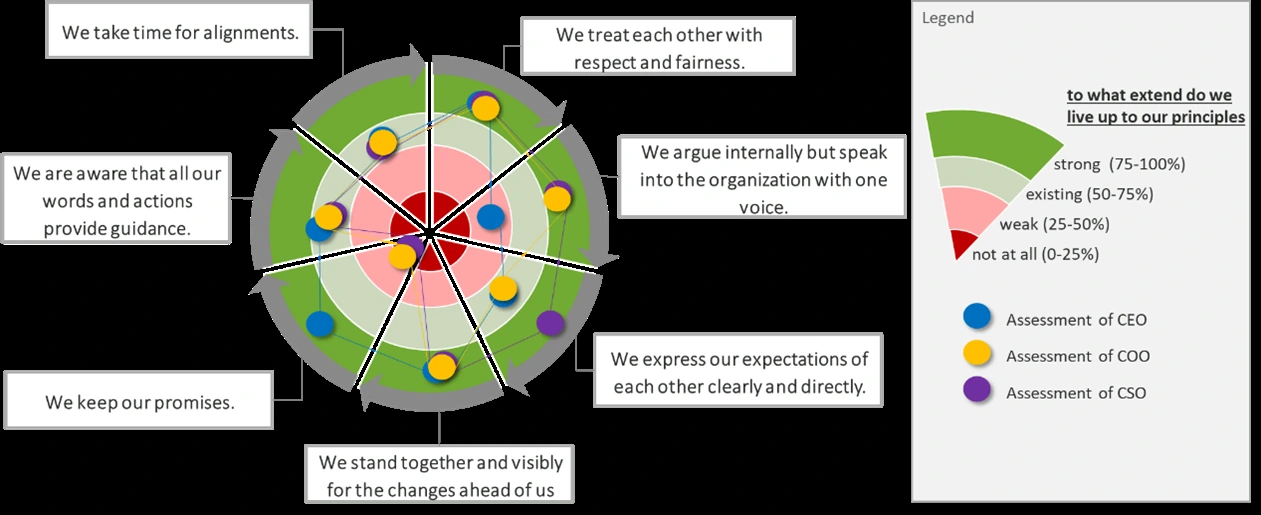 Original illustration from the LinkedIn article.
The leadership monitor can be implemented immediately in a hands-on way on the flipchart
In one client's example, every single executive assesses how they personally perceive the executive team (as a whole) already lives up to the agreed principles by sticking a glue dot on a prepared flipchart at the beginning of every monthly executive team meeting while entering the room as an established routine.
This is already the starting point for the first topic on the agenda of the monthly executive team meeting called: TOP 1 - Reflection on guiding coalition status - duration 10 minutes.
10 minutes is a well-invested amount of time per month to continuously raise awareness on the effectiveness of (executive) leadership teams.
Why don't you start doing it right away in your next management meeting?
Artikel teilen↗
What does this mean for your organisation?
Let’s explore your specific challenge together.
Let’s talk↗