

Most change projects fail, and only one in five is successful. That´s not new to us. The day-to-day business of organizations suffers under permanent change projects. Employees are under enormous pressure: 76 percent complain about the time pressure that projects cause in addition to day-to-day business. On the other hand, the top-management often complains about missing ownership & motivation to drive the change. So, who is right?
Well, I think both are right: If there is no motivation, you won´t see & get any ownership for change initiatives. Ownership on the other hand can motivate but will cause the opposite if you constantly overload your superheroes of the organization. So, let´s have a look at both: Motivation & Ownership. In this article, I will put a spotlight on Motivation first. In one of my upcoming postings, I will look at (right) Ownership to successfully run change initiatives.
Spotlight on: Motivation!
I think it is fair to say that in every single company – at least in the one´s that I know – you somehow have them all:
 Original illustration from the LinkedIn article.
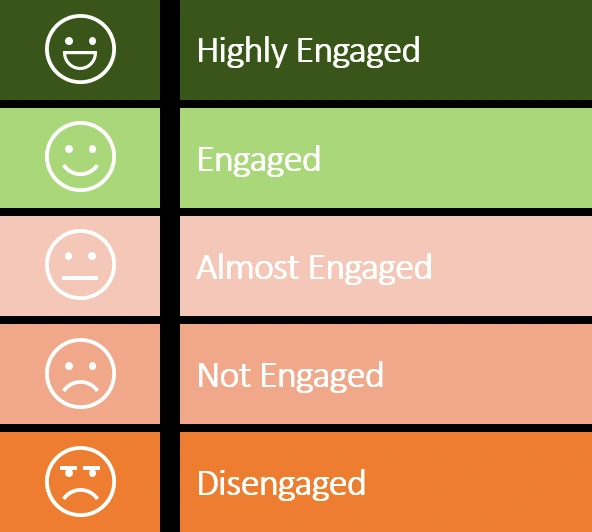
- The highly engaged (“I have a fantastic idea…”)
- The engaged (“Yes, sure, let´s go!..)
- The Almost engaged (“Yes, but….”)
- The Not Engaged (“No, because…”)
- The Disengaged (“I´ve survived so many change programs…”)
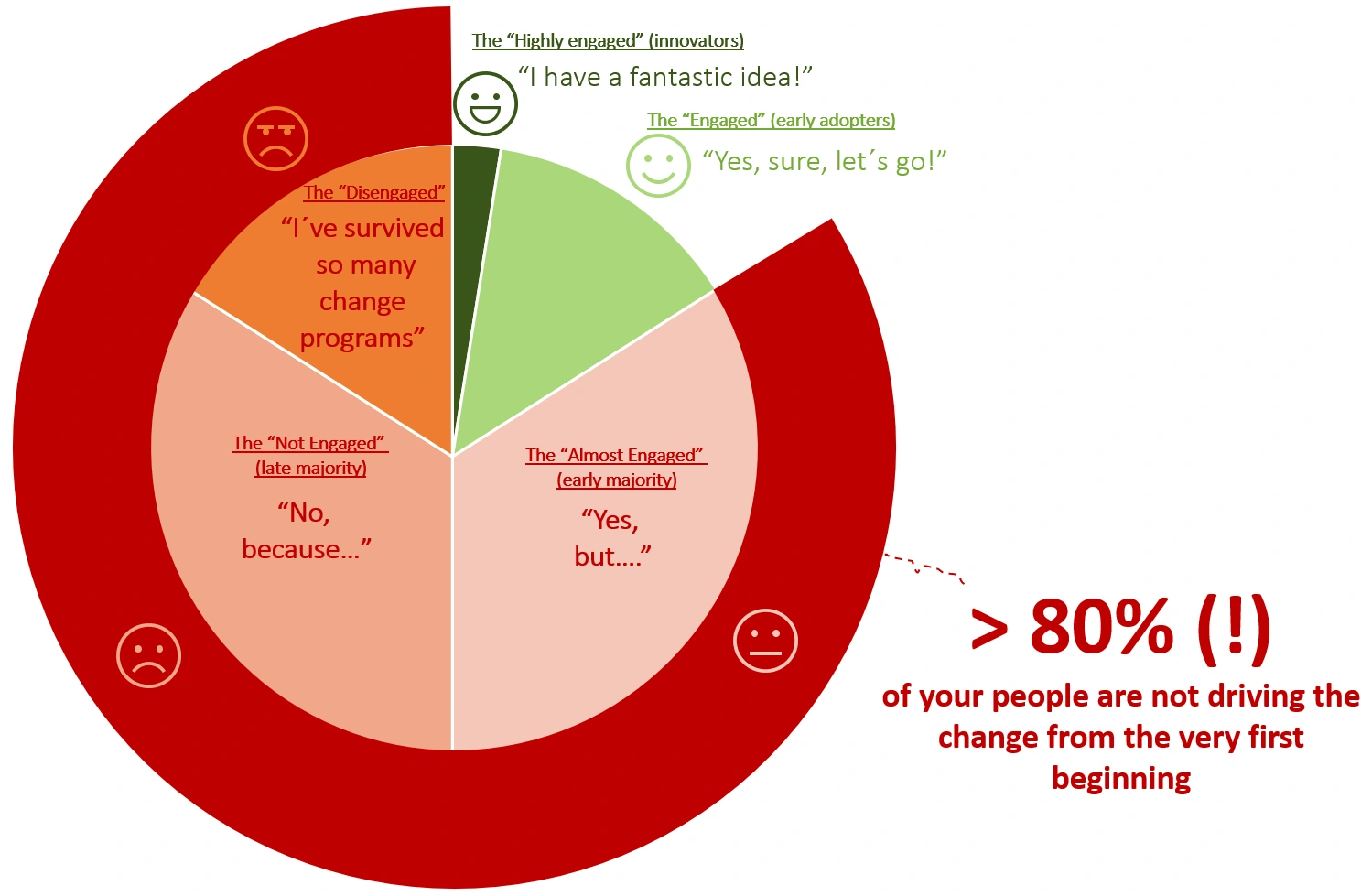
And let´s also state – here, too, many studies agree – that there is an imbalance between the highly engaged + engaged vs. all others. Depending on the nature and scope of change and also depending on the ability of the organization to consciously lead the change, one can assume that more than +/- 80% of the workforce is not actively driving the change from the very first beginning. They are not motivated to change!
 Original illustration from the LinkedIn article.
So how to deal with it?
How can you as a leader influence motivation (for a change) in your team? Well, basically I´m not a psychologist and there are tons of studies around motivation – some say that you can´t motivate people. I think that´s true! Because I´m a pragmatist and also from my own (leadership) experience I would at least agree that If you can't motivate people, then the way we deal with people and the way we treat them has a high impact on DEmotivation at least. Meaning – if +/- 80% are not motivated to change you should be very careful not to demotivate the remaining 20%. Because these are the ones that you should look at when it comes to Ownership for change (watch out for the upcoming part 2).
And here you go with the
TOP5 habits with demotivating effects
that you should immediately stop if you want to obtain motivation with your people:
1. What demotivates: spreading eternal pessimism & not believing in the company’s vision/strategy. You better be optimistic, open, curious, and committed to learning & a constant ambassador of the company’s strategy. To learn more about it watch this:
Watch video: Locating Yourself - A Key to Conscious Leadership
2. What demotivates: Unclear/unrealistic goals, permanent pressure. You better agree on ambitious, yet realistic tasks and goals, give constant feedback, make sure that everyone can play out individual strengths.
3. What demotivates: Doing micromanagement. You better let your people make decisions and give them the freedom to act. Agree on how often you check & discuss progress!
4. What demotivates: Having buddies & cultivating an “inner circle”. You better don´t expect the outer ones to be motivated or you better let them be part of the (inner) circle!
5. What demotivates: Tolerating assh... in your team. You better kick them out!
If you don´t know what is meant by this – watch the video of Simon Sinek on “performance vs. trust”
Watch video: Simon Sinek Performance vs Trust
That’s it on (de-)motivation for today. Watch out for the upcoming posting on (right) ownership to successfully driving change!
And if you have experienced other bad leadership habits with demotivating effects I would love to see them in the comments!
Artikel teilen↗
What does this mean for your organisation?
Let’s explore your specific challenge together.
Let’s talk↗