
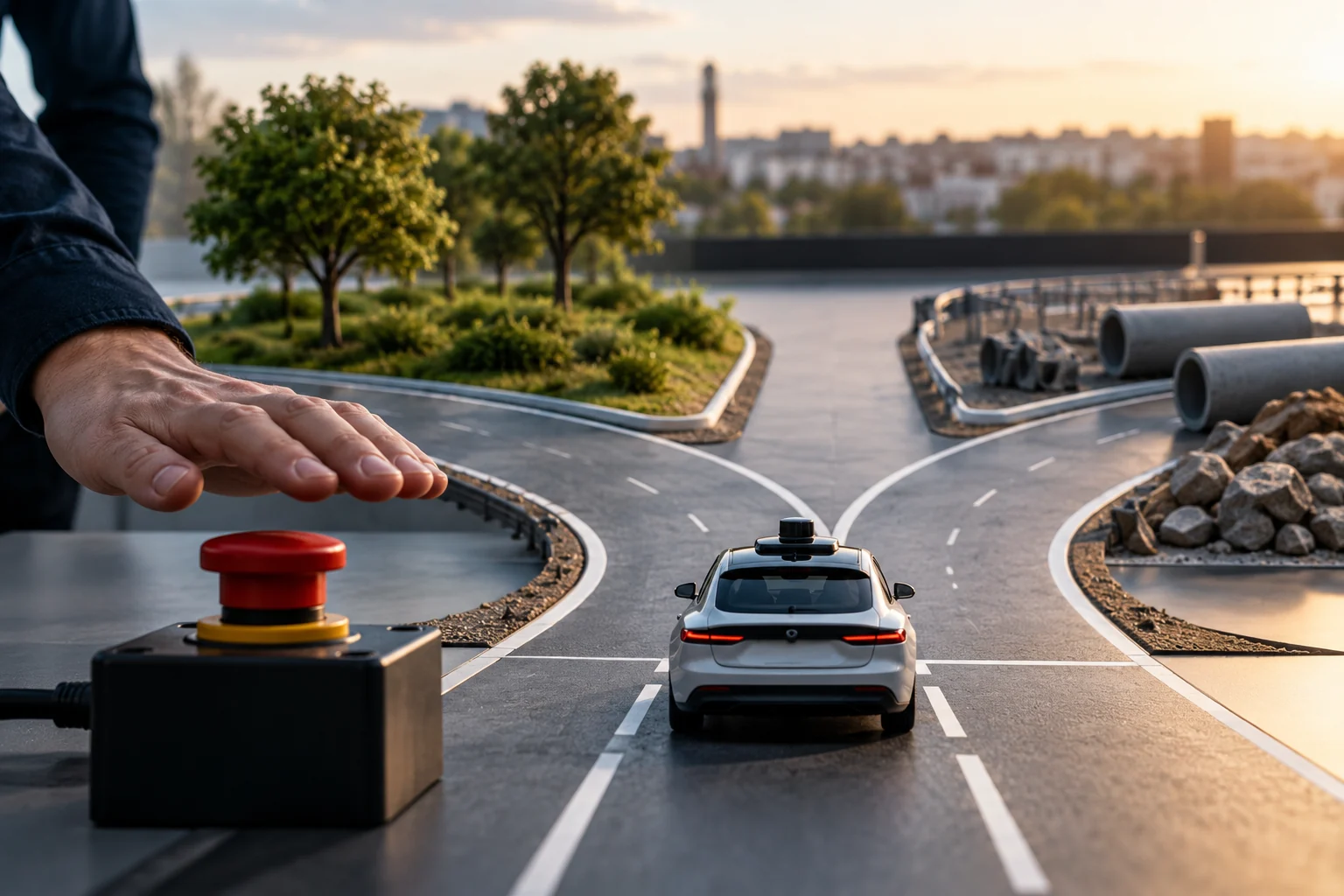
When should AI decisions be impossible?
A future of transport in which Level 5 autonomous vehicles rule the roads promises entirely new experiences. A look at daily life shows what will change when self-driving cars can take us everywhere without us lifting a finger.
🚗 How autonomous vehicles change everyday life
I live on Hamburg’s outskirts and do not drive into the city centre: stop-and-go traffic and finding parking are too stressful. But imagine getting into a self-driving AI, reading while the car handles the traffic, arriving relaxed and getting out directly at your destination. The vehicle can drive off again and find a parking space independently. A short message a few minutes before I want to return is enough, and the car is ready as requested. Then I enjoy the journey home. It sounds like a relaxing future.
But wait! Amid this vision lies a difficult question: how do autonomous vehicles make ethical decisions, especially when human lives are at stake?
♾️ Saving lives versus individual freedom: an example
On a motorway, a Level 5 autonomous vehicle travels beside a car controlled by a drunk driver. That car is about to collide with a school bus carrying 28 children and a driver. The AI in a nearby vehicle could intervene, sacrifice itself—the vehicle—and its occupants, for example a pregnant woman asleep inside, and thus prevent the collision. This decision would have to be immediate. There would be no time to communicate the intention.
👩🏻⚖️ Ethical and legal questions
Should autonomous vehicles be allowed to decide independently, for example to save lives, even if this endangers their occupants? And who bears responsibility when AI makes such a decision?
At first glance, machine learning itself is not the problem. Onboard systems could have the freedom to make these kinds of decisions. Rather, the problem raises a wealth of legal and ethical questions that should be discussed and answered: should an AI take matters into its own hands unilaterally? On what learned basis may AI decisions be made, and what consequences follow?
🤔 Conclusion
As the technological challenges of autonomous driving progress, we face significant ethical questions, for example around autonomous decision-making in potentially life-threatening situations. It is important to address these questions and ensure the safe and ethically responsible integration of autonomous vehicles and AI into society.
What do you think?
Artikel teilen↗
What does this mean for your organisation?
Let’s explore your specific challenge together.
Let’s talk↗