
7
Leadership
United & decisive leadership teams
The most important thing at the end: Leadership! Better said: effective leadership teams .
I have seen many managing directors and top executives who were highly committed to developing strategies but then showed visibly little interest in progress when it came to implementation - this is how strategies fizzle out! To paraphrase Dieter Lange once again: you can recognize winners at the start, losers too: It's often about attitude and trust in leadership teams! The experienced and perceived behaviour of leaders and leadership teams in change processes is so crucial - there is no need for artificially created and therefore ineffective cultural change programmes.
Effectiveness and sustainable results (not only in strategy implementation) are always based on trust. And that starts with leadership. How else can you expect employees to be willing to embark on new, often uncertain, but definitely unknown paths if the management team obviously does not trust itself or is itself unsure whether the chosen strategy or the strategy project to be implemented is the right one? Who would ever get on an airplane if pilots in the cockpit radiated uncertainty, did not trust each other or made contradictory statements about the impending turbulence?
Be honest with yourself: do you really trust each other in your leadership team? Do they treat each other honestly, fairly and openly? The more problems are swept under the carpet, the less success you will achieve in stormy times. Patrick Lencioni's pyramid of the "5 Dysfunctions of a Team" impressively conveys the connections here.
Patrick Lencioni: 5 Dysfunctions of a Team

1 Trust as a foundation
Effective leadership teamwork and successful change, innovation and progress are based on trust. The first level of Lencioni's pyramid illustrates the importance of this. Without trust (lack of trust), open communication and constructive discussions are impossible.
2 Unsolved conflicts with lack of trust
In the possible pursuit of harmony, problems are often concealed or conflicts are not dealt with constructively (Lack of Conflict). These teams tend to have a "yes-man culture", in which decisions are superficially affirmed but inwardly rejected.
3 No commitment with lack of conflict
In the worst-case scenario, you fraternize with one trusted person from the team to "silently say NO together" - which in turn conveys a feeling of legitimacy to the "silent NO". The team members then do not feel obliged to support the decisions made with full commitment (lack of commitment).
4 No accountability with lack of commitment
In a trusting relationship, on the other hand, team members take accountability for implementing the decisions made. However, those who do not support decisions internally will not take responsibility for their implementation (lack of accountability), let alone actively drive them forward.
5 No results with lack of accountability
This finally leads to inadequate results (lack of results) and often also to (hidden) recriminations regarding responsibility for these - true to the motto: "I thought it right away (and didn't say it)!" Does this sound familiar? Then it's time to break this negative spiral.
How about conducting the Lencioni Survey in the management team? This will give you clarity about the current level of trust in the (management) team. You can then reflect on the results - ideally in a moderated team discussion. Consider using the Lencioni survey to gauge trust levels in your management team. Discuss the results in a moderated session, using the Lencioni pyramid to bolster team cohesion and effectively execute your strategy. And above all: As a leader, always emphasize the importance of strategy implementation .
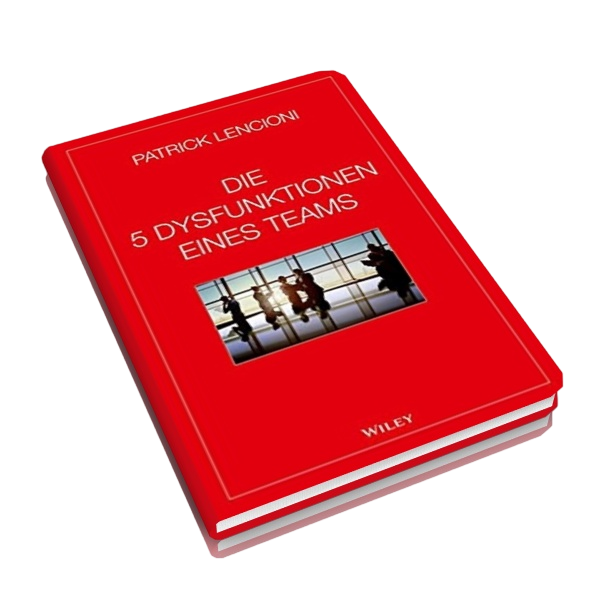
The Five Dysfunctions of a Team
View book on Amazon
7
A personal story to conclude
My football coach at the time, Jürgen - not Klopp, but still good - would sometimes shout loudly and almost angrily onto the pitch just a few minutes after the referee had kicked off the game:

BODY TENSION
Then everyone was aware and sometimes this early wake-up call alone was enough to influence the course of the game in our favor. What had happened? And what is this "body tension" all about? Well, it's about attitude, about the will to succeed, which is clearly visible in the body language of some key players after just a few minutes of play, or not - Jürgen called it: body tension.
And indeed, when I watch team sports from a spectator's perspective nowadays after many years, I can also see after a few minutes which team is on the pitch with the right attitude and is determined to win the game. Do you recognize that? (Sporting) experience shows that the phenomenon of "lack of body tension" is not a distinguishing feature that differentiates good from bad teams. Rather, all teams are equally affected by it. It is precisely the successful teams that are spoilt for success that - at least in sport - suffer a surprising defeat in the next game when they are top of the table and at the bottom of the table. Otto Rehagel - our famous German football coaching legend - is reported to have said: "The truth is on the pitch!" .
This also applies to everyday change processes in organizations: Here, too, the truth lies on the pitch, here, too, the will to change can be seen in the "body tension" of the players on the pitch of strategic change projects. I recently moderated a workshop with executives: The top management of a market leader was concerned that supposedly smaller competitors were increasingly gaining market share. There was a cognitive consensus among the participants that their own competitiveness was at risk despite recent extremely successful financial years: "Compared to the competition, we are 20-30% too expensive, too slow in implementing innovative solutions, too little customer-orientated, too preoccupied with ourselves and too focused on the few existing customers who currently account for over 80% of our business." Changes were needed and were quickly found: Accelerating innovation projects, measures to win back customers and a few "quick wins" on top. That's the short version of the agreed workshop results - the game tactics for the coming weeks and months were discussed and clearly agreed in this workshop, as if in a team meeting shortly before the kick-off of the upcoming match.
Then it was time to get out on the pitch! A few weeks later, almost halfway through the implementation of the agreed short-term measures, we met again for a mid-day break: together we looked at the implementation status of the agreed measures. We came to the sobering realization that everyday life had returned. The "operational business" had struck again - important customer appointments here, worsening problems with productivity at production site x there and in general: corona! Everyone, including the board members, fully understood the chanting of verbose excuses as to why the game was lost in the first half! What would Jürgen have shouted? His wake-up call, of course: B-O-D-Y T-E-N-S-I-O-N!!!
I then shared this story with the board members afterwards and we agreed: as the coach of a (management) team, it's not enough to lament the missed opportunities over a tea half-time break. A leader must be on the pitch and observe the game from the sidelines and, if necessary, intervene appropriately in the game - because: The truth lies on the pitch, even in leadership! Only then is it possible to see the body tension with your own eyes in the first few minutes. Leaders/executives do not need to "shout" onto the pitch from the outside like Jürgen used to. But appropriate feedback and addressing/stating clear expectations are part of the 1x1 of good leadership practice - Jürgen even replaced me once back then - because of a permanent lack of body tension!
What is the level of body tension in your (leadership) team when it comes to strategy implementation?

Or to conclude with the words of the great soccer manager legend Jürgen (Klopp) : We have to change from doubter to believer!
EXECUTION WINS!
Die Prozessschritte im Detail
Klappen Sie eine Version auf, um die Beteiligten anzuzeigen.
Gemeinsam erarbeiten, Schritt für Schritt weiterentwickeln
Jede Workshop-Runde baut auf den Ergebnissen der vorherigen auf. Die Beteiligten arbeiten am aktuellen Entwurf – zum Beispiel an thematischen Marktständen – und geben strukturiert Rückmeldung:
- Was gefällt mir?
- Was ist unklar?
- Was fehlt?
Die Inputs werden im Workshop dokumentiert und anschließend vom Kernteam gebündelt und verarbeitet. Die nächste Version macht sichtbar, was sich verändert hat und welche Hinweise aus welchen Gründen übernommen oder nicht übernommen wurden. So arbeitet der nächste Kreis auf einem gemeinsam weiterentwickelten Stand.
Version 0.1entwerfen
Im ersten Workshop bündelt das Kernteam vorhandene Analysen und Erfahrungen und erarbeitet einen ersten Strategieentwurf: Welche Richtung wollen wir einschlagen, welches Zielbild streben wir an und welche strategischen Ziele und Handlungsfelder zeichnen sich ab? Das Ergebnis wird als Version 0.1 dokumentiert und bildet die Arbeitsgrundlage für die nächste Runde.
Beteiligte
- Kernteam
Version 0.3weiterentwickeln
Geschäftsführung und Kernteam entwickeln im Workshop die Version 0.1 gemeinsam weiter. Sie schärfen die strategische Richtung, konkretisieren das Zielbild und klären erste Widersprüche und offene Fragen; die Ergebnisse werden direkt festgehalten und zu Version 0.3 verdichtet.
Beteiligte
- Geschäftsführung
- Kernteam
Version 0.5weiterentwickeln
Auf Basis der Version 0.3 erarbeiten Geschäftsführung, Kernteam und Top-Führungskräfte im nächsten Workshop den weiterentwickelten Stand. Entlang der drei Feedbackfragen bringen die Führungskräfte ihre Perspektiven und Erfahrungen ein, ergänzen Inhalte und schärfen Ziele und Handlungsfelder; daraus entsteht Version 0.5.
Beteiligte
- Geschäftsführung
- Kernteam
- TOP Führungskräfte
Version 0.6Feedback einholen
Gesellschafter, Geschäftsführung und Kernteam bearbeiten im Workshop die Version 0.5 aus der Eigentümerperspektive: Passt die Richtung, stimmt das Ambitionsniveau und welche Grenzen oder Erwartungen sind zu berücksichtigen? Die Rückmeldungen werden anhand der drei Feedbackfragen aufgenommen und in Version 0.6 eingearbeitet.
Beteiligte
- Gesellschafter
- Geschäftsführung
- Kernteam
Version 0.7Feedback einholen
Im nächsten Workshop wird die Version 0.6 gemeinsam mit der Mitbestimmung, Geschäftsführung, Kernteam und Top-Führungskräften weiterbearbeitet. Im Mittelpunkt stehen die Auswirkungen auf Menschen und Zusammenarbeit, etwa auf Rollen, Qualifizierung und Arbeitsorganisation; Chancen, Bedenken und Ergänzungen fließen in Version 0.7 ein.
Beteiligte
- Geschäftsführung
- Kernteam
- TOP Führungskräfte
- Mitbestimmung
Version 0.8Feedback einholen
Mit Version 0.7 wird der Kreis im Workshop um die Belegschaft und gegebenenfalls weitere Stakeholder erweitert. Die Beteiligten prüfen mit den drei Feedbackfragen, ob die Strategie verständlich und nachvollziehbar ist, und bringen ihre Erfahrungen aus dem Arbeitsalltag ein; die dokumentierten Inputs werden für Version 0.8 gebündelt.
Beteiligte
- Geschäftsführung
- Kernteam
- TOP Führungskräfte
- Mitbestimmung
- Belegschaft
- …
Version 0.9weiterentwickeln
Geschäftsführung, Kernteam und Top-Führungskräfte führen im Workshop die Rückmeldungen der bisherigen Runden zusammen. Auf Basis der Version 0.8 klären sie offene Alternativen, schärfen Ziele und Handlungsfelder und setzen Prioritäten; sie halten nachvollziehbar fest, welche Inputs übernommen werden und welche aus welchen Gründen nicht. So entsteht Version 0.9 als Grundlage für die Verabschiedung.
Beteiligte
- Geschäftsführung
- Kernteam
- TOP Führungskräfte
Version 1.0Strategie verabschieden
Auf Basis der Version 0.9 klären Gesellschafter, Geschäftsführung und Kernteam im abschließenden Workshop die verbliebenen Entscheidungsfragen und verabschieden die Strategie als Version 1.0. Dabei wird sichergestellt, dass die Richtung, die Prioritäten und die nächsten Schritte gemeinsam verstanden sind und verbindlich getragen werden.
Beteiligte
- Gesellschafter
- Geschäftsführung
- Kernteam
Version 1.0Strategie kommunizieren
Nach der Verabschiedung wird Version 1.0 in einem gemeinsamen Kommunikations- und Dialogformat mit allen Stakeholder-Gruppen vermittelt. Geschäftsführung und Führungskräfte erläutern die Richtung, die Entscheidungen und die nächsten Schritte, machen den Beitrag der bisherigen Beteiligung sichtbar und beantworten Fragen. Dieser gemeinsame Auftakt ergänzt die Kommunikation, die bereits während des gesamten Prozesses stattfindet.
Beteiligte
- Gesellschafter
- Geschäftsführung
- Kernteam
- TOP Führungskräfte
- Mitbestimmung
- Belegschaft
- …
Beispiel für ein klares strategisches Framework
Die folgende Grafik zeigt ein strategisches Framework, mit dem wir bei Game Changing Partner arbeiten. Es grenzt die Strategie von der langfristigen Vision und der konkreten Umsetzung ab.
Die Vision gibt die Richtung vor – im Bild als Sonne über dem Berg. Die Strategie konkretisiert diese Richtung in drei miteinander verbundenen Zeithorizonten: langfristige strategische Ziele und Zielbild für heute plus fünf Jahre, mittelfristige strategische Ziele für heute plus drei Jahre und Handlungsfelder für die kommenden ein bis zwei Jahre.
Die Handlungsfelder gehören zur Strategie und bilden die Brücke zur Umsetzung. Innerhalb dieser Handlungsfelder werden konkrete Projekte und Maßnahmen umgesetzt. So wird aus der strategischen Ausrichtung Schritt für Schritt wirksame Veränderung.
Die Ebenen im Überblick
Klappen Sie die Begriffe auf, um die jeweilige Ebene näher kennenzulernen.
VisionHeute +10–15 Jahre
Die Vision beschreibt die langfristig angestrebte Zukunft des Unternehmens. Sie gibt die Richtung für strategische Entscheidungen vor. In der Berggrafik steht dafür die Sonne über dem Berg. Die Vision bildet den Orientierungsrahmen für die Strategie.
Langfristige strategische Ziele & ZielbildHeute +5 Jahre
Das Zielbild beschreibt den angestrebten Zustand und die Positionierung des Unternehmens in fünf Jahren: Wo wollen wir stehen und wie wollen wir aufgestellt sein? Die langfristigen strategischen Ziele konkretisieren, was bis dahin erreicht werden soll.
Mittelfristige strategische ZieleHeute +3 Jahre
Mittelfristige strategische Ziele beschreiben die wesentlichen Ergebnisse, die innerhalb von drei Jahren erreicht werden sollen, um dem Zielbild näherzukommen. Sie sind konkret, messbar und priorisiert. Aus ihnen werden die Handlungsfelder abgeleitet.
HandlungsfelderHeute +1–2 Jahre
Handlungsfelder sind die thematischen Arbeitspakete, die in den kommenden ein bis zwei Jahren bearbeitet werden müssen, um die strategischen Ziele zu erreichen. Sie beantworten die Frage: In welchen Bereichen müssen wir aktiv werden? Als Bestandteil der Strategie bündeln sie die Projekte und Maßnahmen der Umsetzung.
Projekte & MaßnahmenStrategieumsetzung
Innerhalb der Handlungsfelder werden konkrete Vorhaben priorisiert und umgesetzt – mit klaren Ergebnissen, Verantwortlichkeiten und Terminen. Projekte umfassen mehrere aufeinander abgestimmte Schritte; Maßnahmen sind kleinere, direkt umsetzbare Vorhaben. Beide leisten einen Beitrag zu den strategischen Zielen.
Explore further
Selected articles and perspectives on this chapter.